

The Misconception Holding Finance Back
We hear many CFOs and FP&A leaders say:
“We already invested heavily in ERP. Why do we need EPM?”
In this post, we share the different ways Enterprise Resource Planning (ERP) and Enterprise Performance Management (EPM) are not competing systems. They are designed for fundamentally different jobs inside finance. Treating ERP as a substitute for enterprise performance management slows decision-making and traps FP&A teams in backward-looking cycles.
ERP runs finance operations.
EPM runs finance decisions.
“ERP is focused on recording transactions, while EPM focuses on planning, budgeting, forecasting, and reporting on the business.”
— Oracle, What Is EPM?
What Oracle EPM Actually Does in Finance
Oracle EPM is financial planning software built for insight and decisions. EPM answers a very different question: What will happen next, and what should we do about it?
Oracle EPM supports:
- Budgeting and forecasting
- Rolling forecasts
- Scenario and sensitivity modeling
- Driver-based planning
- Management and board reporting
- Variance analysis across financial and operational data
- Monthly Financial Close
- Reconciliation and Transaction Matching
EPM is designed for:
- Frequent change
- Multiple versions of the future
- Rapid iteration
- Collaboration across finance and the business
What Oracle ERP Actually Does in Finance
Oracle ERP is the system of record for finance. ERP answers one core question:
What happened, and is it correct?
This includes capabilities such as:
- General ledger
- Accounts payable and receivable
- Fixed assets
- Subledgers
- Financial close automation
It is designed to:
- Capture and validate transactions
- Enforce controls and compliance
- Support auditability
- Produce historical, accurate financial statements
- Automate the financial close
Why ERP Is Not a Replacement for EPM
EPM depends on ERP as its trusted data foundation. Without clean, controlled financial data flowing from ERP, planning loses credibility.
What Happens When You Try to Do Planning Inside ERP?
Yes, ERP systems can technically support basic planning. But when CFOs attempt to turn ERP into full-scale budgeting and forecasting software, the cracks appear quickly; over time, FP&A becomes reactive instead of strategic. ERP systems are optimized for transaction integrity, not modeling flexibility.
Common Failure Patterns
- Forecasts rigidly tied to the chart of accounts
- Planning cycles locked to month-end close
- Heavy spreadsheet exports and offline modeling
- Customizations that require IT for every change
- Inability to run multiple scenarios simultaneously
Why ERP Alone Cannot Support Modern Forecasting
Modern FP&A no longer means an annual budget and a quarterly reforecast.
Today’s finance leaders need:
- Rolling forecasts updated monthly or continuously
- Driver-based models that reflect the business
- Scenario planning under uncertainty
- Integration of operational drivers (pipeline, usage, capacity)
- Faster insight cycles, not longer close cycles
ERP architectures were never designed for:
- High-volume write-back
- Frequent model changes
- Branching scenarios
- Continuous planning workflows
ERP vs EPM — What Each System is Designed to do
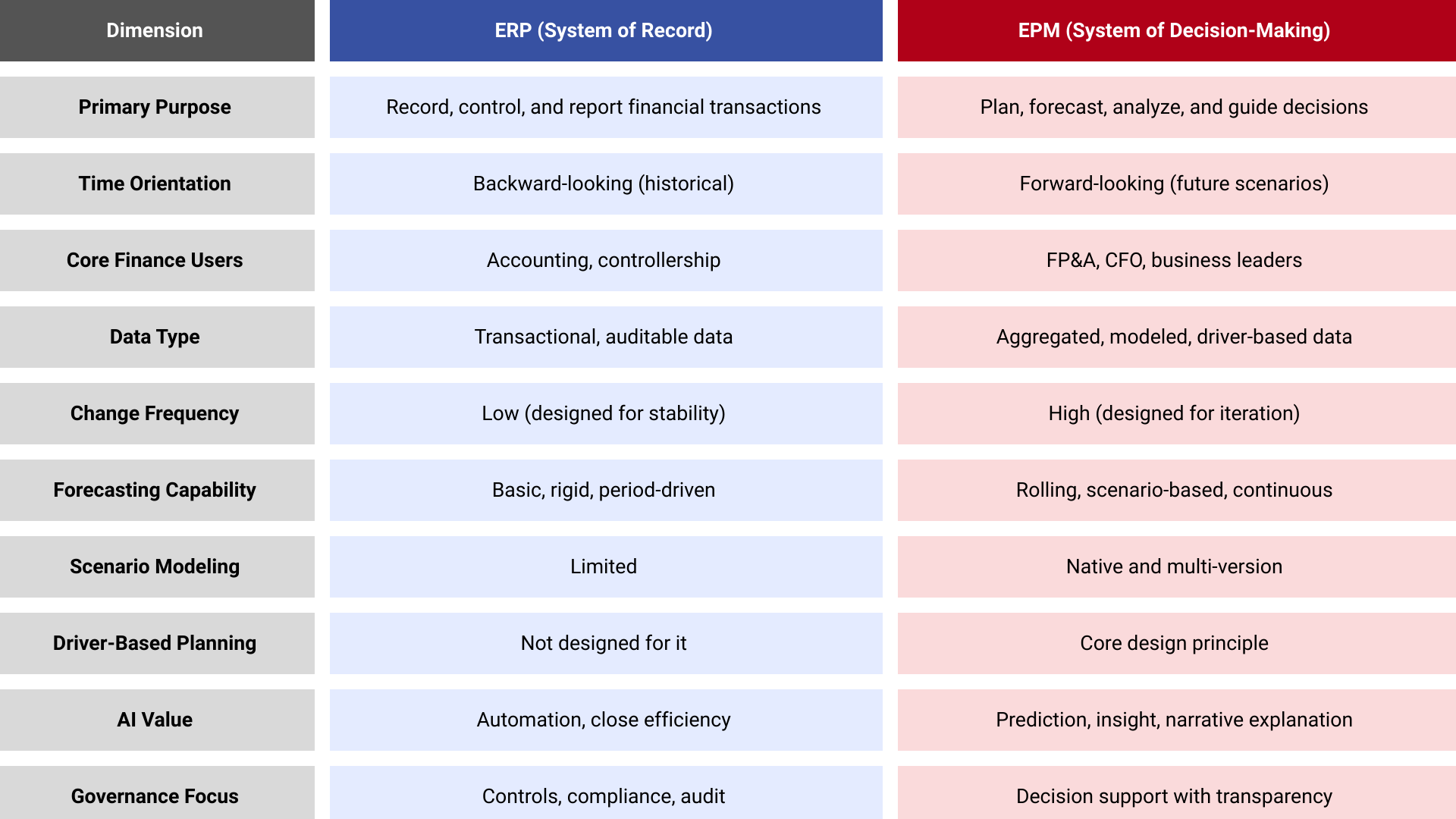
The ERP to EPM Data Flow
The most effective finance organizations follow a clear division of labor:
- Oracle ERP continuously curates clean, auditable financial data
- That data flows automatically into Oracle EPM
- EPM combines financials with operational and external drivers
- FP&A models scenarios, forecasts outcomes, and supports decisions—without touching the ledger
This separation allows:
- Faster forecasting
- Better executive confidence
- FP&A teams focused on analysis, not data wrangling
AI in ERP accelerates operations and AI in EPM accelerates decisions.
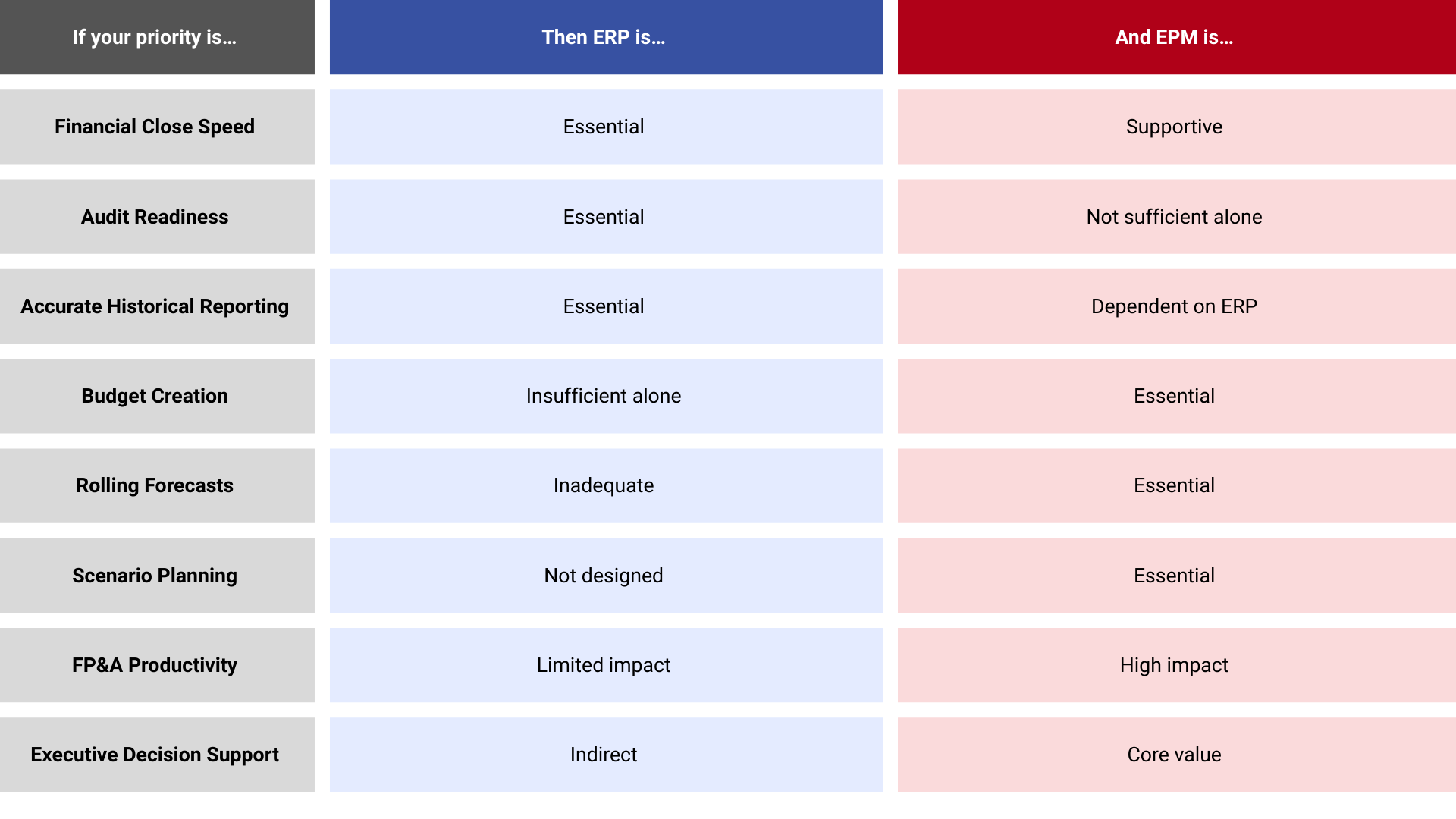
ERP or EPM: A CFO’s Decision Guide to Financial Software
- “What happened?” → ERP
- “What will happen?” → EPM
- “What should we do next?” → EPM
- “How do we ensure control and compliance?” → ERP
- “How do we adapt faster?” → EPM
FAQs
1. What’s the difference between ERP and EPM?
ERP records transactions and manages daily operations. EPM uses that data to plan, analyze, and optimize performance.
2. Can Oracle ERP technically do planning?
Yes, but it lacks the flexibility, modeling depth, and iteration speed required for modern FP&A.
3. Why not just customize ERP?
Customization increases cost, slows change, and often recreates EPM functionality poorly.
4. How does EPM improve forecast credibility?
By separating planning from the system of record while preserving trusted data flows.
5. Does AI make EPM unnecessary?
No. AI increases the importance of having a system designed for planning and decision-making.
Watch the AI World Series on YouTube!